Where People Go Wrong
Most homeowners treat garage door noise like a radio station that's slightly off-tune - annoying, not urgent. Around here that's backwards. A lot of Highland Park houses were built between 1938 and 2003, with the bulk of the stock going up through the 1960s and 70s, which means the hardware on a lot of these doors has been through fifty-plus winters of expansion and contraction. A squeak you've been living with for two years isn't a quirk of the house. It's a roller or hinge that's worn past its tolerance, and in cold weather that tolerance runs out faster than people expect. The mistake isn't ignoring noise - it's assuming all noise is the same. A rhythmic squeak once per rotation is different from a single loud bang, and treating them the same way (usually: do nothing, then call when the door won't move) means you wait until the failure is the expensive kind instead of the ten-minute kind. We'd rather get the call on the squeak.
The Situation
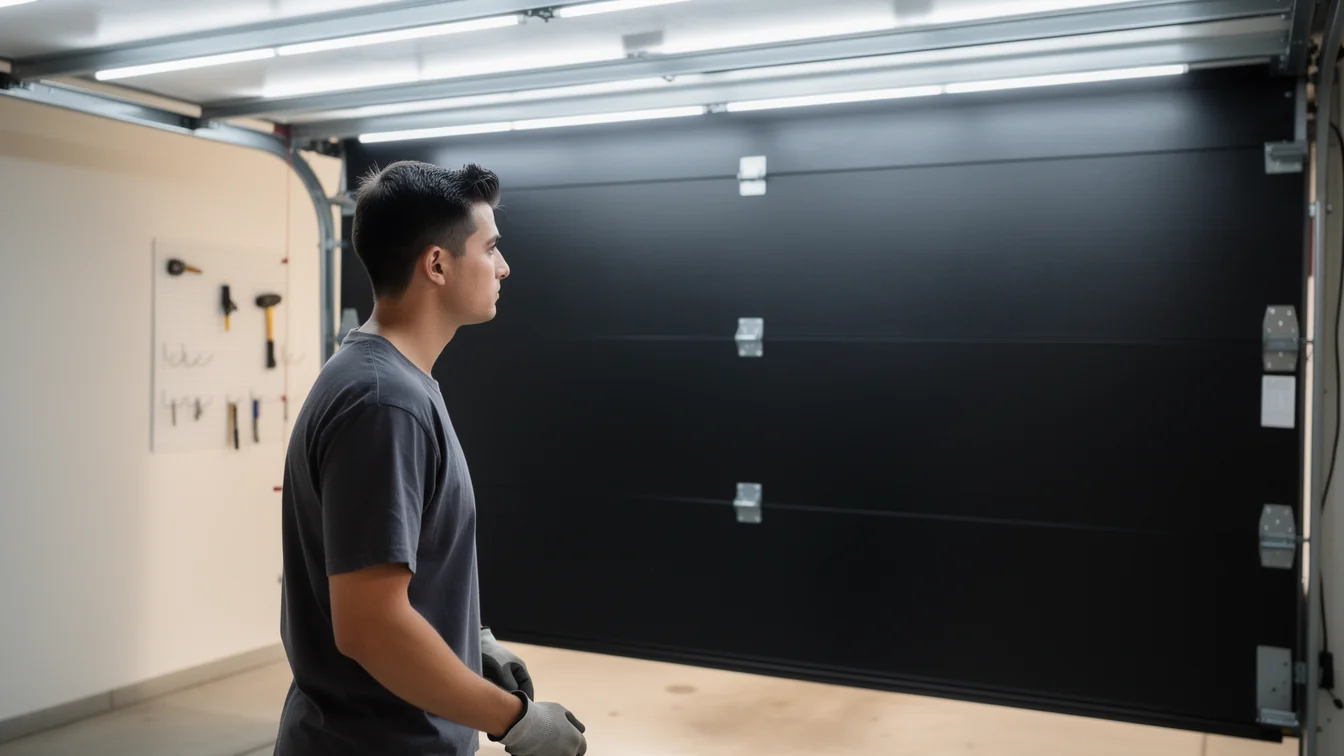
The doors we open up on original 1960s-70s builds are usually on steel track with roller and hinge hardware that was never designed to be maintenance-free for half a century. On a house with a 1977 median build year, that's not a hypothetical - it's the typical job. Galvanized rollers that shipped standard on that era's doors wear a flat spot over time, and a flat spot makes a distinct thudding noise once per wheel rotation, not a continuous squeal. Torsion springs from the same era are closing in on or past their cycle life, and a spring that's about to go often makes a sharp pop or bang on the way up, not a slow fade. Track that's shifted slightly out of alignment - common after decades of seasonal ground movement - makes a grinding or scraping sound that gets worse, not better, over a few weeks. None of these sound the same to someone who hasn't heard a hundred of them, which is exactly why people lump them together and wait.
What Local Conditions Do
Highland Park sits in a cold-moderate climate band, and cold does two specific things to an aging door. First, it stiffens lubricant and tightens metal tolerances, so hardware that was already marginal gets loud before it fails outright - the cold makes the noise worse weeks before the part actually breaks. Second, repeated freeze-thaw cycles work on anything that was slightly misaligned to begin with, so a track that was a quarter-inch off in October can be grinding audibly by January. This is why the loudest service calls we get cluster in the cold months even though the underlying wear has been building all year. A door that's been quietly tightening up all summer announces itself the first hard cold snap. If your door started making noise right after a cold stretch, that's not coincidence - that's the cold finding the weak point that was already there.
What It Costs
We're not going to quote a number here without a part in front of us, because a worn roller and a broken torsion spring are not the same job and we don't want to guess at your expense. What we will say plainly: on houses from the 1960s-70s stock that's common across this area, a roller or hinge replacement is a small job, and a torsion spring on a door that's still structurally sound is a bigger but still contained one. Where it gets expensive is when noise gets ignored long enough that the track bends or the opener motor burns out compensating for binding hardware - at that point you're often looking at replacing more than the part that was actually noisy. If your door is already badly out of alignment or the panels are failing along with the hardware, repair may not be worth it over replacement, and we'll tell you that straight instead of patching a door that's done.
Talk to a local pro
Garage door trouble in Highland Park?
Same-day service with honest, upfront quotes.