Where People Go Wrong
The most common mistake we see on a service call is someone trying to force a door back onto its track by hand, usually after hearing a loud bang or seeing the door hang at an angle. On a house built in the Highland Park housing stock's sweet spot - median year 1977, most of it dating from 1938 to 2003 - the track brackets are often the original ones, lag-bolted into framing that has shrunk and settled for decades. Pulling on a door that's already off true can bend the rail further or snap a cable under load.
Another mistake: assuming a noisy roller is cosmetic. A roller that's worn enough to rattle is usually also worn enough to walk sideways out of the track channel, and once it's riding on the lip instead of inside the groove, the whole door is one hard stop away from coming free. We also see owners spray lubricant straight on the track itself, which does nothing for the real problem and can actually make the rollers slip more instead of less. None of this is complicated work to get wrong - it's just easy to miss until the door is already hanging crooked.
The Situation
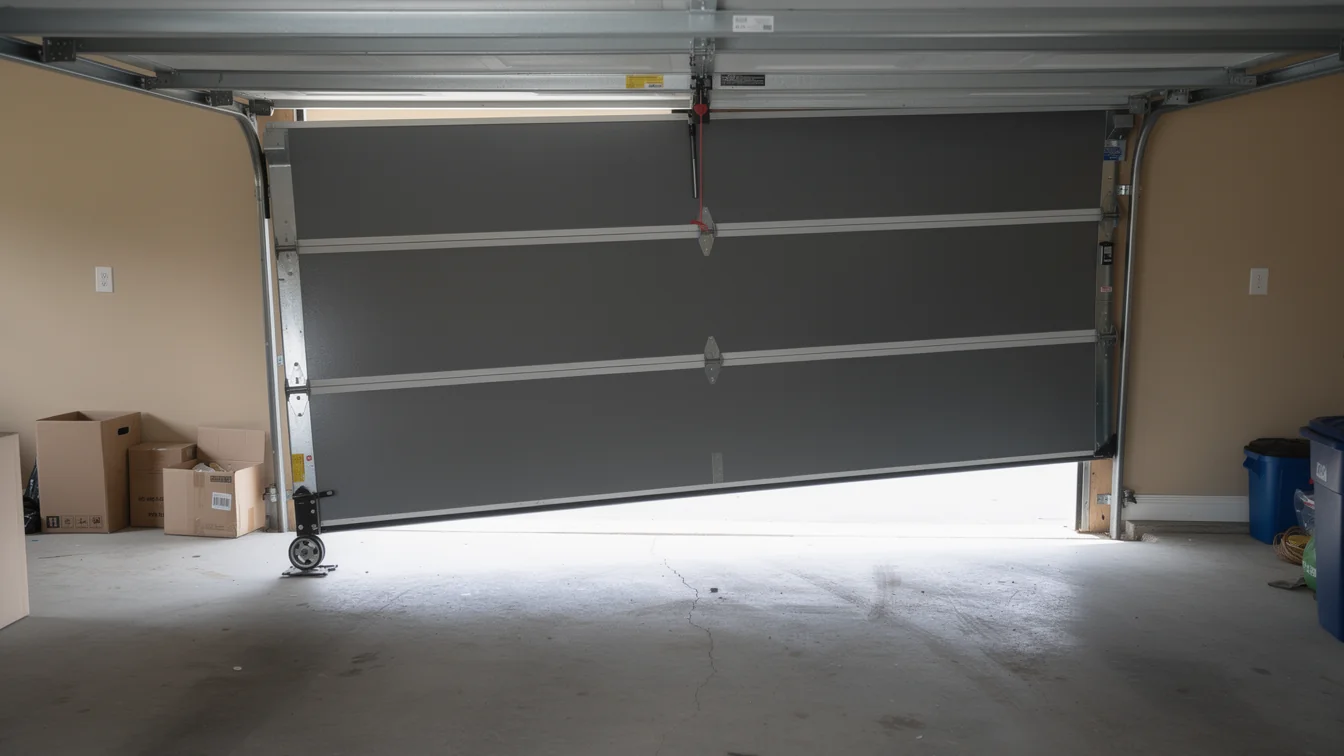
A garage door comes off track for one of four reasons: a bent rail, a roller that's worn past its flange, a bracket that's worked loose from the framing, or a cable that's jumped the drum and let one side of the door drop faster than the other. On homes built in this part of Highland Park's 1960s and 70s wave, the doors that are original to the house are old enough that all four of those parts are near the end of their working life at the same time.
A track installed in 1968 wasn't built to the same tolerance as the galvanized rail sold today, and it's had roughly sixty winters to work loose. When one side of a double door drops even a half inch lower than the other, the rollers on that side ride up onto the edge of the track instead of sitting inside it, and from there it only takes one more open-close cycle before the door is fully off the rail. It's rarely a single cause - usually a worn roller meets a loose bracket meets a slightly bent rail, and the door finally loses the fight on a cold morning when everything is stiffer than usual.
What Local Conditions Do
Highland Park sits in a cold-moderate climate band, and that matters more to a garage door track than most people think. Steel contracts in the cold, which means the clearance between the roller and the track channel is tighter on a January morning than it is in July. A roller that's borderline worn might ride fine all summer and then catch and jump the moment the metal shrinks in winter.
The slab under the track brackets moves too. Freeze-thaw cycling through a Highland Park winter works on the concrete apron the vertical track is bolted to, and a slab that's heaved or settled even slightly throws the whole track out of plumb. On a house with the original track from the 1960s or 70s building wave, that slow seasonal movement has had decades to work the lag bolts loose in the framing behind the brackets. None of this shows up as a dramatic failure - it shows up as a door that's just slightly harder to close than it used to be, right up until the morning it isn't on the rail anymore.
What It Costs
We don't quote a price for an off-track door over the phone, and we won't pretend otherwise here - until someone's eyes are on the rail, the roller wear, and the brackets, there's no honest number to give. What drives the cost is whether this is a bent-rail problem or a parts-replacement problem. Straightening a track that's only mildly bent is a quick fix. A track that's been bent and re-bent, or brackets that have pulled loose from framing that's shrunk over fifty-plus years, usually means replacing hardware rather than reshaping it, which is more labor and more parts.
Highland Park's median household income sits well above the national figure, and we find that a lot of owners here choose to replace worn rollers and brackets proactively rather than wait for a second off-track call - it tends to be the cheaper path over the life of the door. The one thing we'll say plainly: if the door has come off track more than once in a year, patching it again is throwing money at a problem that's going to keep coming back until the worn parts actually get replaced.
Talk to a local pro
Garage door trouble in Highland Park?
Same-day service with honest, upfront quotes.